







































RGB vs RGBIC LED Strip Lights — What's the Difference and Which Should You Buy?
Quick answer: RGB strips show one colour across the entire strip at a time. RGBIC strips use IC chips to split the strip into independently controlled zones — each zone can show a different colour simultaneously, enabling rainbow gradients, colour-chase effects, and music-reactive multicolour patterns. RGBIC costs more, has limited cutting points, and requires a compatible IC controller. For gaming setups and TV backlights, RGBIC. For cove ceilings, accent lighting, and simple mood lighting, RGB or warm white single-colour strips are the better choice.
Both RGB and RGBIC strips produce colour-changing light. Both use red, green, and blue LEDs. Both connect to a controller. The listings look almost identical. But they work fundamentally differently — and choosing the wrong one means either paying for capability you will never use, or being disappointed when the strip cannot produce the effects you wanted.
This guide explains exactly how each technology works, what effects are and are not possible with each, and which is the right choice for every common use case in Indian homes.
How RGB LED strips work
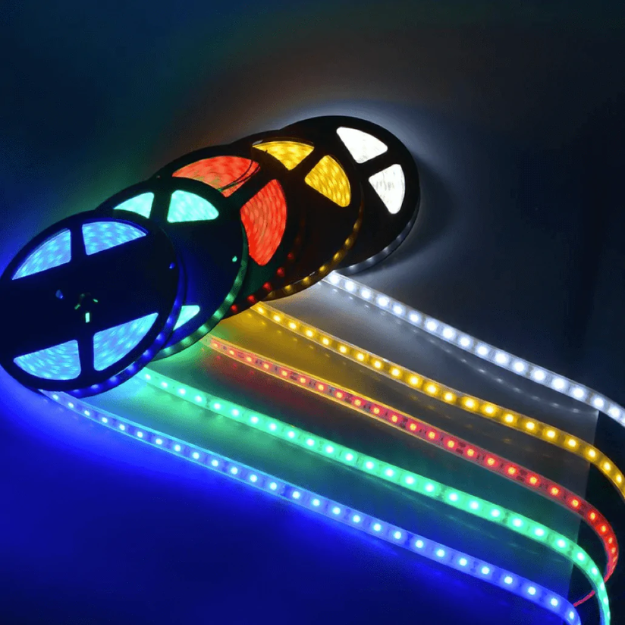
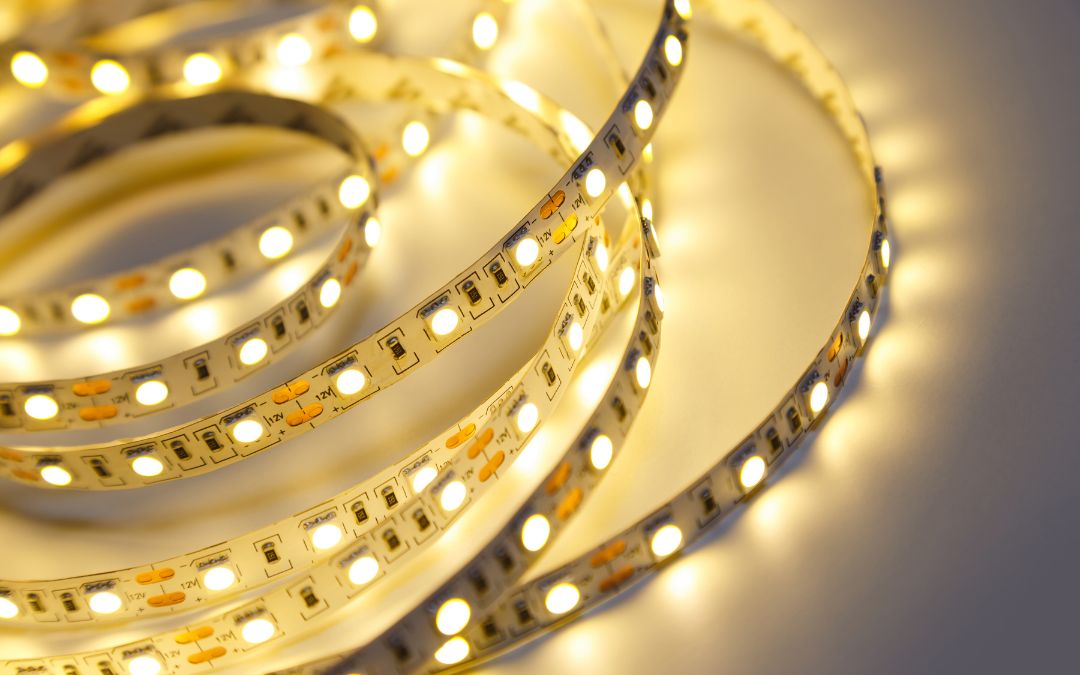
RGB stands for Red, Green, Blue. An RGB LED strip has clusters of three LEDs — one red, one green, one blue — repeated at regular intervals along the strip. A single controller manages all of these clusters simultaneously.
When you select a colour on the remote or app, the controller sends the same signal to every LED cluster on the strip at the same time. The entire strip changes to that colour together. Red signal: the whole strip turns red. Purple signal: every cluster mixes its red and blue LEDs at the same intensity across the full length.
This means RGB is fundamentally a uniform colour system — one colour, across the whole strip, at any given moment. You can change colours, run pre-programmed patterns like flash or fade, and adjust brightness — but the entire strip always does the same thing simultaneously.
What RGB can do: solid colour, colour change, flash, strobe, fade between colours, slow twinkle — all uniformly across the full strip.
What RGB cannot do: display different colours on different sections of the same strip at the same time. No rainbow, no gradient, no zone-specific control.
How RGBIC LED strips work
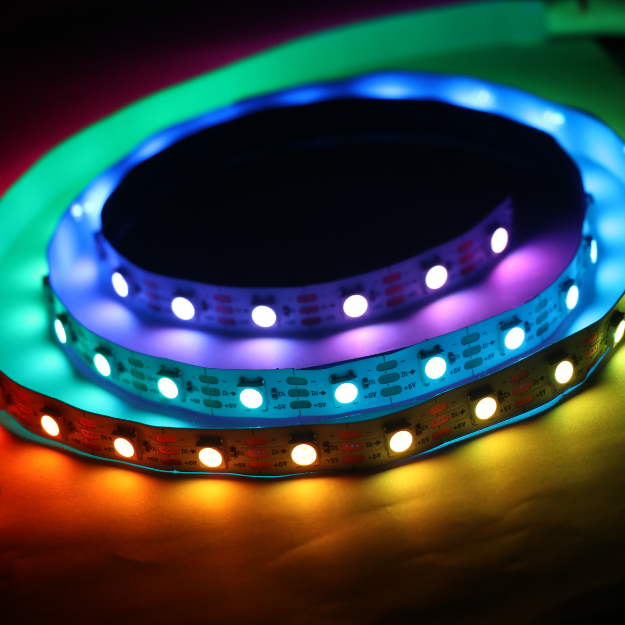
RGBIC stands for Red, Green, Blue, Independent Control. The key addition is the IC — integrated circuit — chips embedded at regular intervals along the strip, typically every 10–20cm.
Each IC chip acts as a local controller for a small zone of LEDs. Instead of one signal going to all LEDs simultaneously, the main controller sends individual signals to each IC chip independently. Chip 1 gets a red signal. Chip 2 gets a blue signal. Chip 3 gets a green signal. All at the same time, on the same strip.
The result: a rainbow across a single strip, a colour-chase animation where colours appear to flow along the strip, music-reactive lighting where different zones pulse to different frequencies, and gradient effects where one end of the strip blends into a different colour at the other end.
What RGBIC can do: everything RGB does, plus simultaneous multicolour zones, gradients, colour-chase animations, music-reactive zone effects, and any pattern where different sections of the strip show different colours.
What RGBIC cannot do: be cut freely. This is the critical limitation — more on this below.
RGB vs RGBIC — full comparison
| Feature | RGB | RGBIC |
|---|---|---|
| Colour display at one time | One colour — entire strip uniform | Multiple colours simultaneously — each zone independent |
| Rainbow / gradient effect | No | Yes |
| Colour-chase animation | No | Yes |
| Music sync | Basic — whole strip reacts together | Advanced — different zones react to different frequencies |
| App / smart home control | Some models | Most models — more advanced app features |
| Cutting flexibility | Every 3–6 LEDs (every 2.5–5cm) | Between IC chips only (every 10–20cm) |
| Controller compatibility | Standard RGB controller | Must use compatible IC controller — not interchangeable |
| Price | Lower | Higher (20–50% more for same length) |
| Lifespan | ~50,000 hours | ~30,000–50,000 hours (IC chips add potential failure points) |
| Installation complexity | Simple | Slightly more complex — controller pairing required |
| Best for | Mood lighting, accent, TV backlight, cove colour accent | Gaming setups, entertainment rooms, feature walls, music-reactive displays |
The cutting limitation — why it matters for installation
This is the most practically important difference and the one most frequently overlooked before purchase.
RGB strips can be cut at marked cut points every 2.5–5cm (every 3 or 6 LEDs depending on the strip). This gives considerable flexibility to fit the strip precisely to any space.
RGBIC strips can only be cut between IC chips — typically every 10–20cm. The IC chips are embedded in the strip at fixed intervals. Cutting through a chip destroys that chip and makes the section beyond it non-functional. You cannot recover this.
In practice, this means:
- If your installation has an awkward length that falls between IC chip cut points, you either waste strip or the fit is imprecise
- For installations with many tight corners and short sections — inside furniture joinery, custom shelving, narrow recesses — RGB gives you more control over exact lengths
- For long uninterrupted runs — a TV backlight, a gaming desk edge, a single feature wall — RGBIC's cutting limitation is rarely a problem
Before buying RGBIC, measure your installation carefully. If any section is shorter than 15–20cm, check whether an RGBIC strip can be cut to that length at an IC chip interval. If not, reconsider.
Controllers — why you cannot mix and match
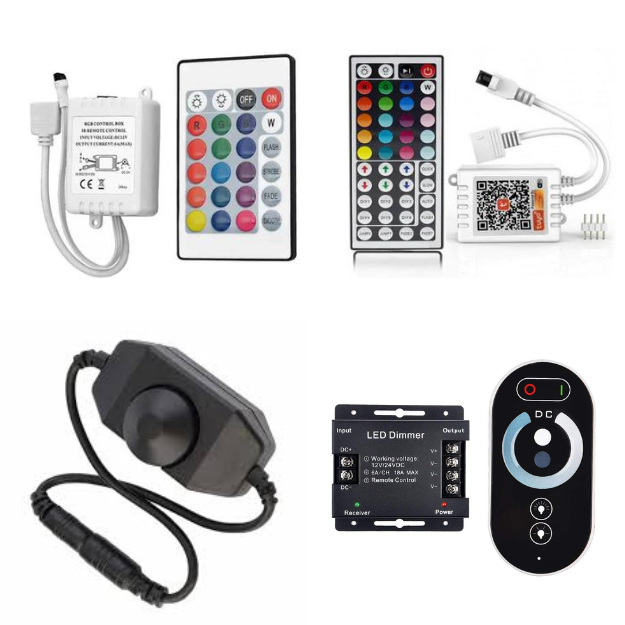
RGB and RGBIC strips use fundamentally different control signals. An RGB controller sends one set of colour instructions to all LEDs simultaneously. An RGBIC controller sends individual zone addresses to each IC chip.
If you connect a standard RGB controller to an RGBIC strip, the strip will light up — but only as a single uniform colour. All zones will show the same colour simultaneously. You lose the entire point of RGBIC. The multicolour capability is simply not accessible without the IC controller.
Similarly, connecting an RGBIC controller to a standard RGB strip will not work correctly — the controller sends zone signals that the RGB strip has no hardware to interpret.
Rule: always buy the controller and strip from the same product family, or verify controller compatibility explicitly before purchasing separately. If you are replacing a controller on an existing RGBIC installation, match the IC chip protocol (WS2811, WS2812B, SK6812 are common protocols — the replacement controller must support the same protocol).
What about RGBW? — a third option worth knowing
RGBW strips add a fourth chip — a dedicated white LED — alongside the red, green, and blue. This matters because RGB strips produce white light by mixing all three colours simultaneously, which creates a slightly cool, often slightly unnatural white. A dedicated white chip produces cleaner, more accurate white light.
| Type | White light quality | Colour range | Best for |
|---|---|---|---|
| RGB | Approximate (mixed from R+G+B) | 16 million colours | Pure colour-changing applications |
| RGBW | Accurate (dedicated white chip) | 16 million colours + clean white | When you need both colour and quality white light |
| RGBIC | Approximate (mixed from R+G+B) | 16 million colours, multizone | Dynamic multicolour effects, gaming, entertainment |
If you want a strip that can do colour effects in the evening and function as clean ambient white light in the day — RGBW is worth considering. For pure colour effects without a white light requirement, RGB or RGBIC depending on your effect needs.
Which to choose — use case guide
| Use case | Best choice | Why |
|---|---|---|
| Gaming desk or battlestation | RGBIC | Colour-chase and music-reactive effects are the point. Zone control creates the immersive setup gaming rooms are built around. |
| TV backlight (bias lighting) | RGB or RGBIC | RGB is sufficient for simple ambient backlight. RGBIC enables screen-matching colour zones that react to on-screen content — a genuine upgrade for entertainment rooms. |
| Bedroom mood lighting | RGB | Simple colour change is all that is needed for bedroom ambient. RGBIC capability goes unused. RGB is simpler, cheaper, and easier to control. |
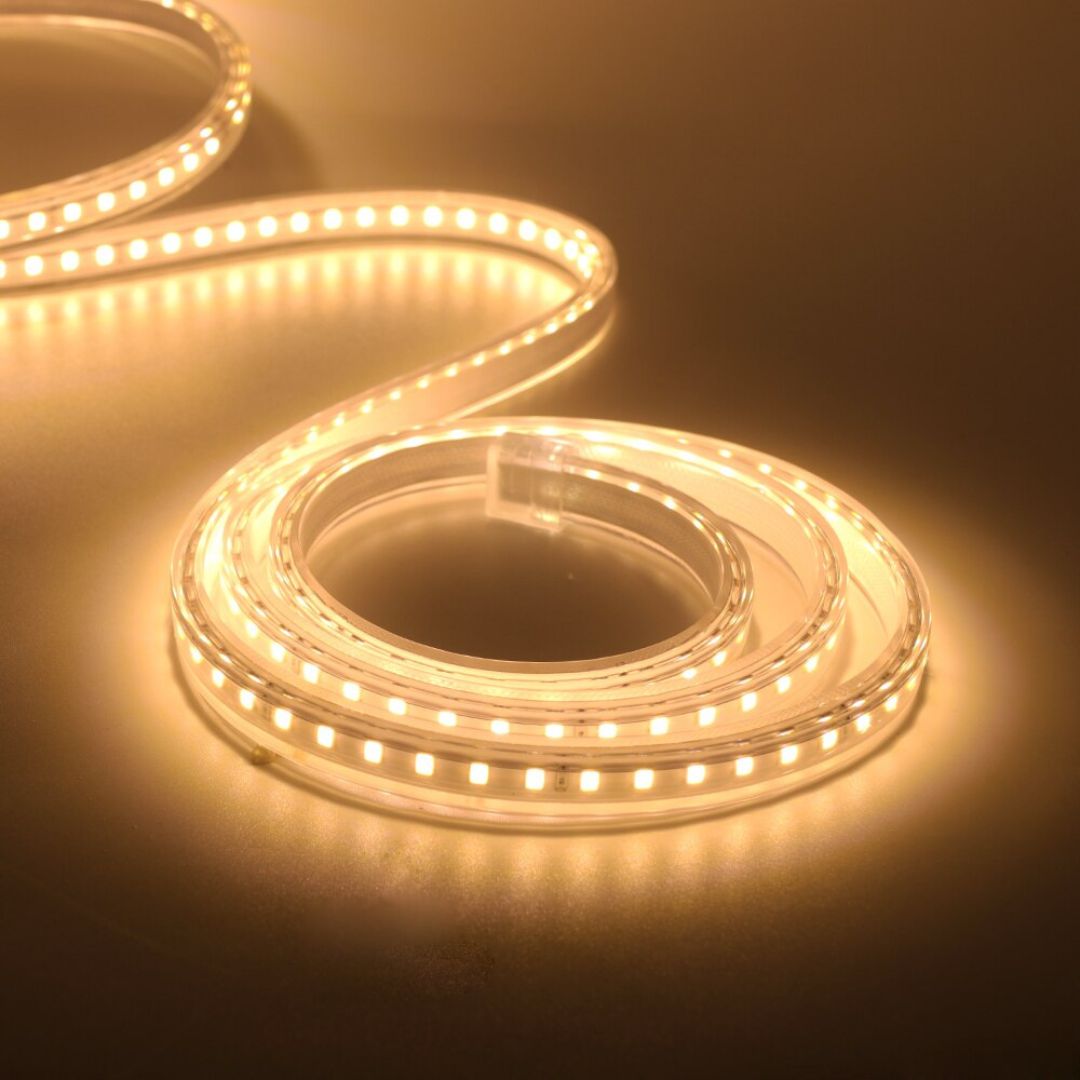
| Cove / false ceiling accent | Warm white single-colour strip | Cove lighting works best with consistent, even colour. RGB or RGBIC multicolour in a cove rarely looks good in a standard residential setting. Use warm white for cove, add a separate RGB strip for accent if colour effects are wanted. |
| Feature wall / entertainment backdrop | RGBIC | A feature wall with gradient or animated lighting is exactly what RGBIC is designed for. The multizone effects create depth and movement that is impossible with RGB. |
| Under-bed / under-furniture glow | RGB | Indirect accent glow — single colour is sufficient. RGB is simpler and more cuttable for the short, precise lengths often needed under furniture. |
| Shelf and bookcase display | RGB or warm white | Single colour or warm white renders books and objects most attractively. RGBIC multicolour on a bookshelf tends to look busy. |
| Kids' room decoration | RGB | Colour changing is engaging for children. Full multizone control is unnecessary. RGB with a simple remote is easier for children to operate. |
| Café / restaurant ambience accent | RGB (subtle single colour) | Hospitality settings use colour very sparingly — typically one warm accent tone. Full RGBIC multizone effects look inappropriate in most restaurant environments. |
| Event / stage backdrop | RGBIC | Events and stage setups benefit from dynamic multicolour effects, music sync, and animated patterns — all RGBIC strengths. |
The most common mismatch we see: buyers purchasing RGBIC strips for cove lighting because "it can do more." In a cove ceiling, the strip is hidden — the only thing visible is the wash of light on the ceiling surface. Multicolour zone effects in a cove look chaotic rather than designed, and most homeowners end up setting the controller to a single warm white mode permanently. The RGBIC capability goes entirely unused. Save the budget and use a high-CRI warm white strip for cove lighting. Use RGBIC where the strip itself is visible and dynamic effects are the intention — gaming rooms, TV walls, entertainment setups.
Price difference — is RGBIC worth the extra cost?
RGBIC strips typically cost 20–50% more than comparable RGB strips of the same length and LED density. The premium pays for the IC chips, the more complex manufacturing, and the advanced controller.
The premium is worth it when:
- Dynamic multicolour effects are the primary purpose of the installation
- The strip will be visible — on a desk, behind a TV, on a feature wall
- Music-reactive zone lighting is a specific requirement
- Screen-matching bias lighting for a home cinema setup is needed
The premium is not worth it when:
- The strip is in a cove ceiling where only the ceiling wash is visible
- Simple colour change at room level is all that is needed
- The installation requires many precise short cuts
- Budget is the primary consideration
Frequently asked questions
What is the difference between RGB and RGBIC LED strip lights?
RGB strips change the entire strip to one colour at a time — every LED shows the same colour simultaneously. RGBIC strips have IC chips at intervals that divide the strip into independently controlled zones — each zone can show a different colour at the same time, enabling rainbow gradients, colour-chase animations, and music-reactive multicolour effects. RGBIC does everything RGB does, plus independent zone control.
What does RGBIC stand for?
RGBIC stands for Red, Green, Blue, Independent Control. The IC refers to integrated circuit chips embedded at regular intervals along the strip — typically every 10–20cm. Each chip controls a zone of LEDs independently, allowing different colours on different sections of the same strip simultaneously.
Can RGBIC LED strips be cut?
Only at IC chip intervals — not freely like standard RGB strips. Cutting through an IC chip permanently damages that section. Cut points on RGBIC strips are typically every 10–20cm. If your installation needs cuts shorter than this, standard RGB gives more flexibility. Always check the specific product for its cut point interval before purchasing.
Is RGBIC better than RGB?
RGBIC is more capable — it can do everything RGB does plus multizone effects. Whether it is better depends on your use case. For gaming setups, TV backlights, and feature walls where dynamic multicolour effects are the purpose — RGBIC is the right choice. For cove ceilings, bedroom mood lighting, and any accent use where a single uniform colour is sufficient — RGB is simpler, less expensive, and easier to install.
Do RGB and RGBIC strips use the same controller?
No — they are not compatible. RGBIC strips must use an IC controller that sends individual zone signals. Connecting a standard RGB controller to an RGBIC strip will work but you lose all zone control — the strip will only show one uniform colour. Always pair RGBIC strips with a compatible IC controller from the same product range.
Can I use RGBIC strips for cove ceiling lighting?
Technically yes, but it is the wrong choice for most residential cove lighting. Cove lighting works best with consistent even colour across the full perimeter. RGBIC's multizone effects — while impressive on a gaming desk — look chaotic on a ceiling and go unused in practice. For cove lighting, a high-CRI warm white single-colour strip is the right choice. Use RGBIC where the strip itself is visible and dynamic effects are the intention.
What are RGB LED strips best used for?
RGB is best for: TV backlighting, under-bed or under-furniture glow, bedroom mood lighting, gaming desk edge accent, shelf display lighting, kids' room colour effects, and festive decoration. RGB is simpler, more cuttable, less expensive, and compatible with more controllers than RGBIC — it is the right choice wherever simple colour change at room level is the requirement.
Shop colour-changing LED strip lights at Chronos Lights
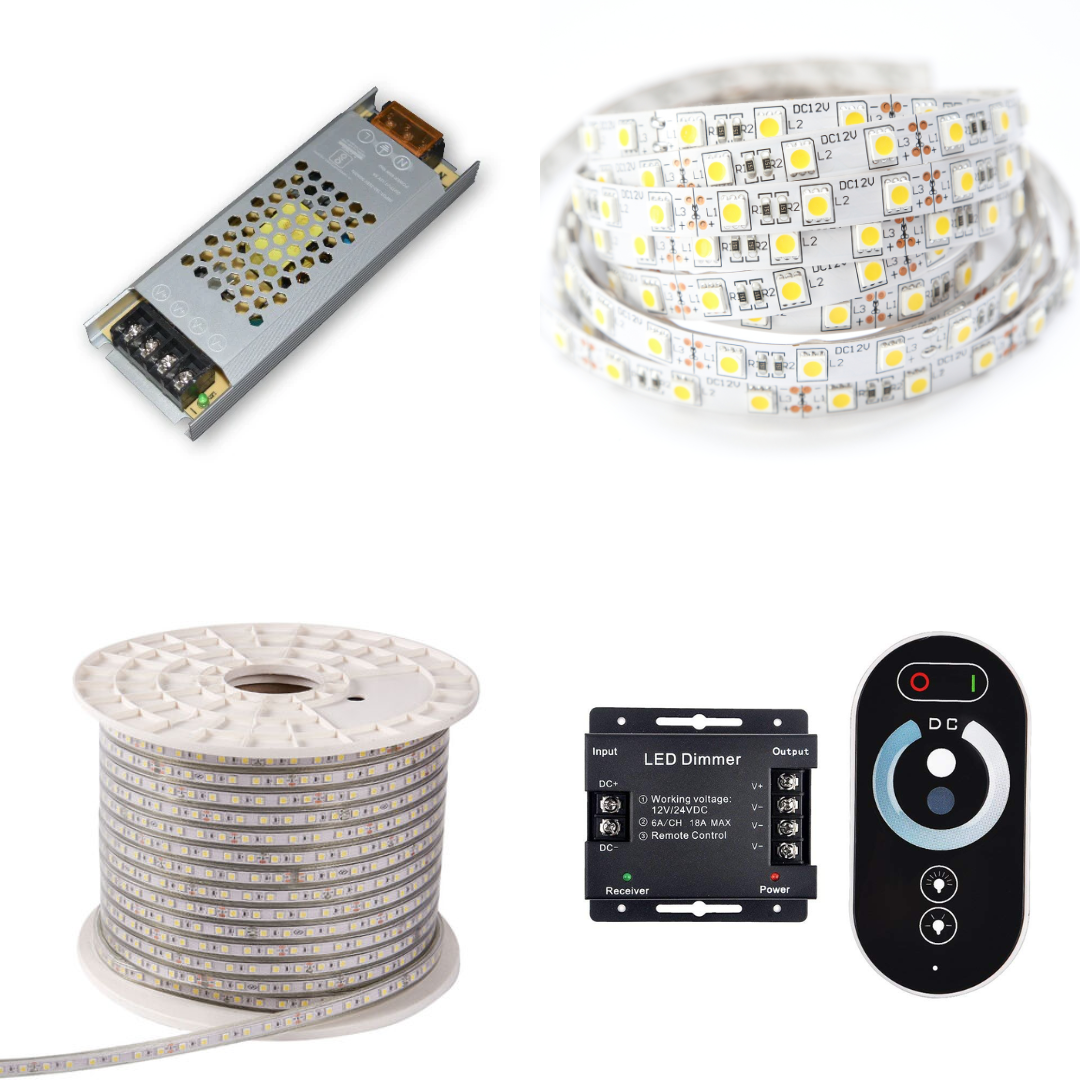
Chronos Lights stocks RGB strip lights for every common accent and mood lighting application — TV backlights, gaming rooms, bedroom mood lighting, and under-furniture glow. All with remote control and multiple effect modes.
- Browse all LED strip lights — including RGB options
- LED strip controllers — remote and app-controlled
- High CRI 98+ Warm White Strip — for cove ceilings (not RGB) — ₹2,999
Not sure which strip is right for your project? Contact our team via WhatsApp with your room dimensions and intended use — we will recommend the right product.