






















What Is CRI in LED Lights — and Why It Matters for Your Home
Quick answer: CRI stands for Colour Rendering Index. It measures how accurately an LED light shows the true colours of objects compared to natural daylight, on a scale of 0 to 100. The higher the number, the more natural colours appear. For home lighting, CRI 90 or above is recommended. For retail, hospitality, and high-end residential spaces, CRI 95+ is the professional standard.
You have chosen your wall paint carefully. You have picked curtains, furniture, and accessories that work together. Then the lights go on and everything looks slightly wrong — flatter, duller, somehow off. The paint colour does not match the swatch. The timber floors look grey. Your skin looks washed out in the mirror.
In most cases, this is a CRI problem — not a design problem.
CRI is the single most overlooked specification in home lighting. Most buyers compare wattage and colour temperature, buy whatever is cheapest, and live with lighting that quietly undermines every design decision they have made. Understanding CRI takes five minutes and changes how you evaluate every LED light you buy.
What does CRI mean?
CRI stands for Colour Rendering Index. It is a standardised measurement developed by the International Commission on Illumination (CIE) that quantifies how accurately a light source reveals the true colours of objects, compared to a reference light source — either natural daylight or incandescent light, depending on colour temperature.
CRI is measured on a scale from 0 to 100:
- CRI 100 — colours appear identical to how they look under natural sunlight. Incandescent and halogen bulbs score close to 100.
- CRI 90+ — excellent. Colours appear natural and accurate. Recommended for homes and most commercial spaces.
- CRI 80–89 — good. Acceptable for utility areas. Some colours appear slightly muted.
- CRI below 80 — poor. Colours look flat, desaturated, and sometimes unidentifiable. Not recommended for living spaces.
The technical process: a light source is tested against 8 standardised colour samples (called R1 through R8). Each sample is scored on how accurately the light renders it compared to the reference. The average of those 8 scores is the CRI, also written as Ra.
CRI vs colour temperature — two different things
This is the most common point of confusion in lighting. CRI and colour temperature are completely independent measurements. They describe different qualities of light.
Colour temperature (measured in Kelvin) describes how warm or cool the light appears. 2700K is warm amber-white. 4000K is neutral. 6500K is cool blue-white.
CRI describes how accurately the light reveals the colours of objects it illuminates — regardless of how warm or cool the light looks.
| Light source | Colour temperature | CRI | What this means |
|---|---|---|---|
| Budget LED strip, warm white | 3000K | 72 | Warm-looking light that makes colours appear dull |
| Quality LED strip, warm white | 3000K | 95 | Warm-looking light that makes colours appear natural |
| Budget LED strip, cool white | 6000K | 70 | Cool-looking light that makes colours appear flat and grey |
| High-CRI LED strip, cool white | 6000K | 95 | Cool-looking light that renders colours accurately |
A warm white light does not automatically render colours accurately. A cool white light is not automatically harsh. The two specifications are independent — you need to check both when buying any LED product.
What low CRI looks like in practice
Low CRI is subtle but pervasive. Most people sense something is wrong with their lighting without being able to name it. Here is what it looks like in specific situations:
In a bedroom
Under CRI 70–75 lighting, the navy blue cushion and the black t-shirt look the same colour. The warm cream wall paint you chose looks slightly yellow and flat. Skin tones in the mirror look washed out or slightly grey. The room does not feel relaxing — it feels slightly clinical despite the warm colour temperature.
In a kitchen
Fresh vegetables look less vibrant. The green of herbs appears dull. Meat looks grey rather than pink. The marble countertop loses its depth and veining. Cooking under low-CRI light makes food look less appetising — and makes it harder to judge whether something is cooked through by colour.
In a living room
The warm terracotta on the accent wall looks brownish-orange rather than the rich earthy red it should be. Timber floors look flat. Artwork loses its depth and saturation. The carefully chosen interior palette you spent months deciding looks somehow generic.
In a wardrobe
The classic problem: navy socks and black socks look identical. Dark green and dark brown are indistinguishable. You pack the wrong colour for a trip or wear a mismatched outfit in good faith.
What high CRI looks like in practice
The difference between CRI 80 and CRI 95+ in a living room or bedroom is immediately visible to anyone who has experienced both. It is not subtle once you know what you are comparing.
Under CRI 95+ lighting:
- Wall paint colours match the swatch accurately
- Timber floors show their natural grain and warmth
- Skin tones appear warm and healthy — not flat or grey
- Fabrics show their true colour — you can distinguish navy from black
- Food looks fresh and appetising
- The room feels cohesive — lighting works with the design rather than against it
This is why interior designers and architects specify CRI as a primary criterion, often before wattage or fixture style. The light quality determines how the entire space is perceived.
CRI ranges explained — which do you need?
| CRI range | Quality rating | Best for | What you notice |
|---|---|---|---|
| CRI 98–100 | Premium | Art galleries, showrooms, high-end residential, photography studios | Indistinguishable from natural daylight. Subtle tonal variations fully visible. |
| CRI 95–97 | Excellent | Hotels, restaurants, retail display, premium homes | Colours pop naturally. Skin tones look warm. Materials reveal full texture and depth. |
| CRI 90–94 | Very good | Living rooms, bedrooms, kitchens, offices | Colours accurate and vibrant. Noticeably better than CRI 80. Recommended minimum for home living spaces. |
| CRI 80–89 | Good | Corridors, utility rooms, storage, general commercial | Most colours rendered adequately. Some muting on saturated colours. Acceptable but not ideal for living areas. |
| CRI below 80 | Poor | Industrial, warehouse, external security | Colours appear flat and desaturated. Not suitable for homes, retail, or hospitality. |
What is R9 — and why most buyers miss it
Standard CRI (Ra) is calculated from 8 pastel colour samples — R1 through R8. These samples cover a range of mid-toned hues but notably exclude deep red.
R9 is a separate measurement specifically for saturated deep red. It is not included in the Ra calculation, which creates a significant gap in what standard CRI tells you.
A light source can score CRI 90 Ra and still have an R9 score of 20 — meaning deep reds appear muted or brownish under that light. This matters in several specific situations:
- Skin tones — red is a significant component of warm, healthy-looking skin. Low R9 makes skin appear flat or slightly grey even under warm-white light.
- Food presentation — the red of meat, strawberries, tomatoes, and many cooked dishes depends on strong R9 rendering. Low R9 makes food look less fresh and less appetising.
- Interior design — terracotta, burgundy, rust, and warm brown tones all depend on accurate red rendering. Low R9 shifts these colours toward grey-brown.
- Retail — products in warm or red tones look significantly better under high R9 light. Clothing, cosmetics, and food retail are particularly affected.
What to look for: For home living spaces, ask for R9 above 50. For hospitality, retail, and premium residential, R9 above 90 is the professional standard.
Chronos Lights CRI 98+ strips are tested with R9 values above 90. This is what separates a genuinely high-CRI product from one that meets the Ra number on paper but falls short in practice.
When specifying strip lights for a hotel or restaurant project, we always ask for the R9 value in addition to CRI Ra. We have seen products marketed as CRI 90+ with R9 values below 30 — which means the lighting looks excellent on paper but makes food and skin tones look poor in the actual space. For any hospitality or premium residential project, treat R9 as a required specification, not an optional bonus.
Does CRI affect energy consumption or brightness?
No — CRI is entirely independent of energy consumption and brightness.
A high-CRI LED and a low-CRI LED at the same wattage use exactly the same amount of electricity. CRI only affects light quality — how colours appear — not how much power the light uses or how many lumens it produces.
Similarly, a dim light and a bright light can both have CRI 90. Brightness is determined by wattage and lumen output. CRI is determined by the spectral quality of the light — which LEDs are used and how the phosphor coating is formulated.
The practical implication: there is no efficiency penalty for choosing high-CRI lighting. You pay slightly more upfront for better LED chips, but your electricity bill is identical.
Room-by-room CRI recommendations for Indian homes
| Room / Space | Recommended CRI | Colour temperature | Why |
|---|---|---|---|
| Living room | CRI 90+ | 2700–3000K warm white | Wall colours, furnishings, and artwork need accurate rendering. Skin tones in social spaces should look warm and natural. |
| Master bedroom | CRI 90+ | 2700–3000K warm white | Wardrobe use requires colour differentiation. Relaxing ambience needs warm, natural-feeling light. |
| Kitchen | CRI 90+ | 3500–4000K natural white | Food preparation requires accurate colour to judge freshness and doneness. Natural white suits task lighting. |
| Dining area | CRI 95+ | 2700–3000K warm white | Food presentation and skin tones under dining light are where CRI impact is most noticed. High R9 critical here. |
| Home office / study | CRI 90+ | 4000K natural white | Accurate colour reduces eye strain for extended work. Document colours, screen work, and design tasks benefit. |
| Bathroom | CRI 90+ | 3000–4000K | Mirror use requires accurate skin tone rendering for grooming and cosmetics application. |
| Children's room | CRI 80–90 | 3000–4000K | Bright, natural-feeling light for play and homework. CRI 90 preferred if budget allows. |
| Corridor / utility | CRI 80+ | 3000–4000K | Colour accuracy less critical. Standard CRI 80 acceptable for transitional spaces. |
| Hotel room / suite | CRI 95+ | 2700–3000K warm white | Guests judge hotel quality by how they look in mirrors and how the space feels. High CRI is a direct quality signal. |
| Restaurant dining | CRI 95+, R9 90+ | 2700–3000K warm white | Food and skin tone rendering directly affects guest perception of food quality and overall experience. |
How to check the CRI of a product before buying
On any reputable LED strip or fixture, CRI should be listed as a specification — typically written as "CRI 90+" or "Ra ≥ 90". If a product does not list CRI at all, the CRI is almost certainly below 80 and the manufacturer does not want you to know.
What to look for on a product specification sheet:
- CRI Ra — the standard 8-sample average. Look for 90 or above for home use.
- R9 value — listed separately. For hospitality and premium residential, look for R9 above 50. For dining and hotel use, R9 above 90.
- LED chip — reputable chip manufacturers (SANAN, Cree, Seoul Semiconductor, Nichia) are more likely to produce consistently high-CRI output. Unbranded chips are harder to verify.
- Third-party testing — reliable suppliers provide independent lab test reports (LM-79 test reports) that verify the published CRI value.
At Chronos Lights, all CRI specifications are verified through independent testing. Our CRI 98+ strip lights are tested across the full R1–R9 range — the full test report is available on request for project specifications.
Frequently asked questions
What is CRI in LED lights?
CRI stands for Colour Rendering Index. It is a measurement of how accurately an LED light reveals the true colours of objects compared to natural daylight. CRI is measured on a scale from 0 to 100 — 100 means colours appear identical to natural sunlight. The higher the CRI, the more natural and accurate colours appear under that light source.
What CRI is good for home lighting?
CRI 90 or above is recommended for all home living spaces — bedrooms, living rooms, kitchens, and bathrooms. At CRI 90+, colours appear natural and accurate, skin tones look warm, and fabrics and paint colours show their true character. CRI 80–89 is acceptable for utility areas like corridors and storage rooms where colour accuracy is less important.
Is CRI the same as colour temperature?
No — they are completely different measurements. Colour temperature (in Kelvin) describes whether the light appears warm or cool. CRI describes how accurately the light reveals the colours of objects it illuminates. A warm white 3000K light and a cool white 5000K light can both have CRI 90 — they look different in tone but both render colours accurately. Always check both specifications.
What is R9 in LED lighting?
R9 is a separate measurement of how accurately a light source renders deep red — the most challenging colour for LEDs. Standard CRI (Ra) is calculated from 8 pastel samples and does not include R9. A light can score CRI 90 Ra but have an R9 value below 30, meaning reds, skin tones, and warm earth tones appear muted or brownish. For dining, hospitality, and spaces where skin tones matter, always ask for the R9 value in addition to CRI Ra.
Does high CRI LED use more electricity?
No. CRI has no effect on energy consumption. A CRI 98 LED and a CRI 75 LED at the same wattage use exactly the same amount of electricity. CRI only determines light quality — how accurately colours appear — not power draw or brightness.
What CRI should I use for a false ceiling in India?
For a false ceiling in a living room or bedroom in India, CRI 90+ is the recommended minimum. This ensures wall paint, furnishings, and skin tones all appear as intended. For premium projects where interior design and material quality is a priority, CRI 95+ or CRI 98+ delivers a noticeably better result — colours are richer, materials feel more authentic, and the space reads as higher quality.
Why does CRI matter for hotel and restaurant lighting?
In hospitality settings, CRI directly affects how guests perceive food, skin tones, and the overall quality of the space. Under low-CRI lighting, food looks less appetising, skin tones appear flat, and the interior materials lose their depth. High-CRI lighting (95+, with R9 90+) makes food appear vibrant and fresh, skin looks warm and natural, and interior finishes — wood, stone, fabric — reveal their full texture. Most professional hospitality designers specify CRI 95+ as a minimum for dining and guest rooms.
Shop high-CRI LED strip lights at Chronos Lights
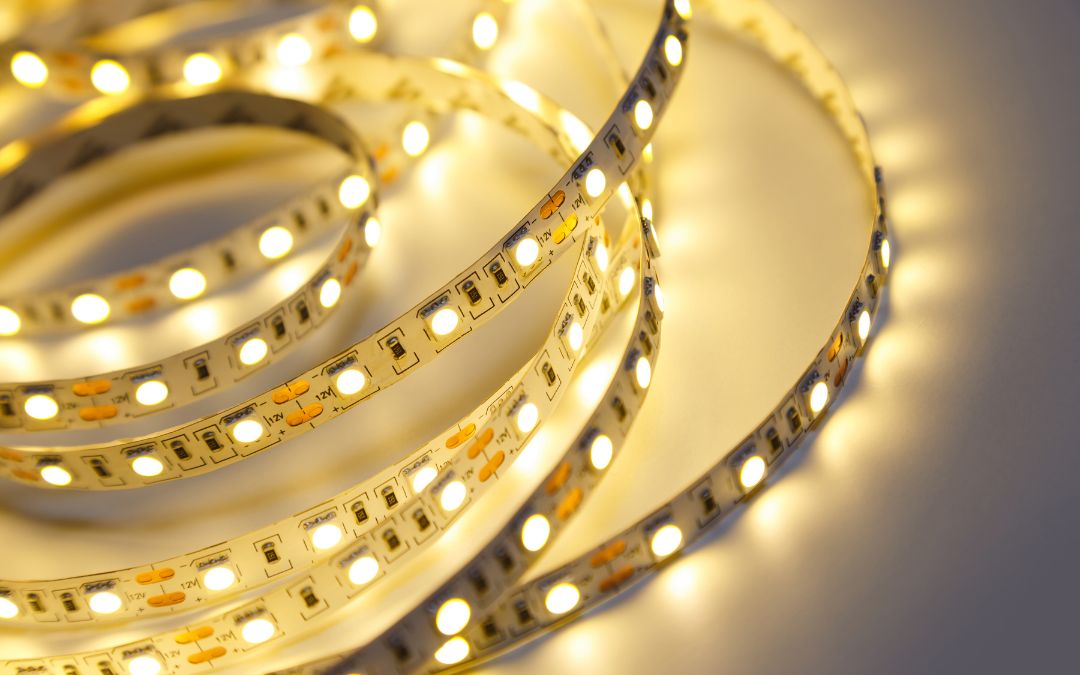
Chronos Lights offers LED strip lights up to CRI 98+ with verified R9 values above 90. Available in warm white, natural white, and cool white — all in 24V for cove ceilings and architectural applications. Suitable for homes, hotels, restaurants, and retail installations.
- High CRI 98+ LED Strip — Warm White (3000K), 24V, 192 LEDs/m, 10m roll — ₹2,999
- High CRI 98+ LED Strip — Natural White (4000K), 24V, 192 LEDs/m, 10m roll — ₹2,999
- High CRI 98+ LED Strip — Cool White (6000K), 24V, 192 LEDs/m, 10m roll — ₹2,999
- Browse all LED strip lights
- Silicone diffuser profiles for cove lighting
Specifying for a hotel, restaurant, or residential project? See bulk pricing, MOQ, and project supply information. Full CRI test reports available on request for B2B projects.